
What I Actually Pack in a Carry-On When I Travel Solo
At first the things you have packed appear to be…
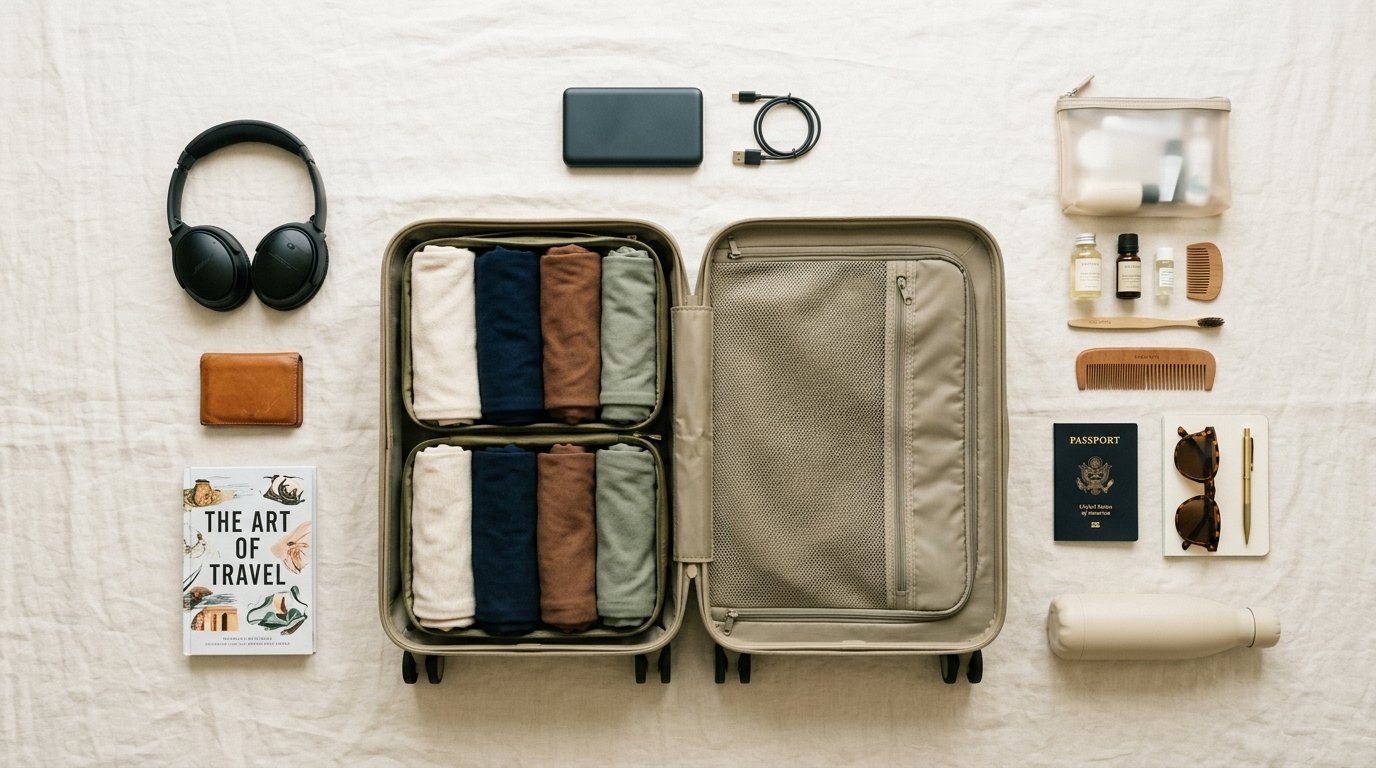
At first the things you have packed appear to be all manageable on the floor of the bedroom, but when you come across a station with a staircase instead of an escalator or a guest house on the fourth floor without an elevator you realize exactly what you have packed.
If you are travelling by yourself, no one will take the other side of the bag. You are responsible for all the items, having to keep account of them and to repack them at 6 a.m. That is why it is advisable to pack lightly. The reason for doing so has nothing to do with being a minimalist.
Here is the kind of list I would give to a friend who was off for about a week; if the trip is longer then laundry becomes more important, and the list doesn’t suppose that you need a specific gadget or a certain type of shirt.
Check your ticket first
The ‘carry-on approved’ indication on a bag’s label is of very little importance; it’s the airline’s rules that matter.
When you look at the details of your booking, check the size, the weight, and whether your ticket includes an overhead bag, an under-seat bag, or both. If you are travelling with more than one airline, then check each flight individually since they usually differ. Also, measure your packed bag with the wheels and handles on and weigh it before you leave home.
Security rules are entirely separate, and it’s possible for an item to go into your bag and yet still be taken away at screening.
When you’re preparing your ticket and your route, take only a bag that is not the largest one you have.
The list
The clothing that is counted refers to the outfits you are wearing on the day of travel, which is why you shouldn’t accidentally pack a second travel outfit.
Documents and money
Passport, plus any visa or entry paperwork
Tickets and accommodation confirmations
A main card and a backup
A little cash
Insurance details and the assistance number
Copies of key documents, stored somewhere safe
The address and contact details for your first night’s stay
Clothes (about a week)
Four or five tops
Two bottoms that work with all of them
One light sweater or fleece
Underwear for five to seven days
Socks suited to your shoes
Sleepwear
One comfortable walking pair of shoes, and a light second pair only if you have a real reason
Weather protection for where you’re going
Toiletries
Toothbrush and small toothpaste
Deodorant
Shampoo and body wash, only if your accommodation doesn’t supply them
Sunscreen
Basic skincare
Comb or small brush
Menstrual products and other personal needs
Medication, with supporting paperwork where required
Electronics
Phone, cable, wall charger
Plug adapter if you need one
Power bank (more on that below)
Headphones
A laptop or camera only if you’ll actually use it
Small extras
Water bottle (empty at security)
A small day bag
Sunglasses
A laundry bag
Earplugs and an eye mask
A few plasters
A pen
You have no need to purchase any of these items—begin with the things you already possess and only address the gaps that are important.
Backpack or wheeled bag?

A backpack is generally the better choice if your trip involves a lot of stairs, cobbles, and transfers. On the other hand, wheels are less stressful for the back when your journey is mainly made up of airports, taxis, and one main destination. Neither option is universally superior.
What is important is attempting to carry the bag when it is fully packed. Can you carry it up a flight of stairs? Can you get it into a rack without assistance? Do you then manage to reach your passport without having to unpack it?
Don’t forget to check the empty weight as well since a heavy suitcase has already taken some of your allowance before you’ve put anything in it, and don’t fill all the pockets just because they exist; leave some space so that you will be able to repack after your first night.
The bag: the items you carry, the length of time you’ve owned it, and the one thing about it that you would like to change.
Clothes: pack what you’ll actually wear
Select two types of bottom that you actually enjoy wearing and then some tops that will match both of them. In this way you’ll have a variety of combinations without having to put together a different outfit for every day. Any item of clothing that requires special shoes or careful ironing brings with it more effort than it’s worth when you’re on a sightseeing trip. You should try out any clothes you’re unfamiliar with before taking them abroad, not on the plane.
You can cover a longer distance by doing your laundry. For a two-week trip you won’t need to take twice as many clothes. Find out if the place you’re staying at has a washing machine or whether there’s a laundrette close by. If you’re going to wash the clothes by hand, then consider how long it will take to dry them and where you’ll hang them. Also, avoid doing your laundry the night before an early departure since wet clothes make bad luggage.
No item takes up more space than shoes, so wear the more cumbersome pair when you’re going out and have the other pair do the job of handling the hostel showers, the beach, or one more formal event. You should never pack a pair of shoes that you haven’t broken in beforehand.
Toiletries: keep them small
Take only the items that you actually need and carry them in quantities suitable for the journey. If an item is essential or difficult to replace, then take enough of it. If it’s easy to find, then don’t.
Using solid toiletries reduces the need for liquid containers, though this is optional. A product you know well in a smaller bottle will usually be just as effective. Anything that has a tendency to leak should be placed in a sealed pouch.
The liquid rules (check them again close to departure):
The United States (TSA) states that containers must be 100 ml / 3.4 oz or smaller and all have to fit inside one quart-sized bag.
The EU recommends that the containers hold 100 ml or less and be placed in a single transparent resealable bag whose capacity does not exceed one litre.
There are exceptions, such as in some cases where medical requirements are involved. A 200 ml bottle that is half full is still a 200 ml bottle.
Electronics: bring what you’ll use
Your phone could already be serving you as a map, a boarding pass, a book, and a camera. Before you go on to get a laptop, a tablet, and a mess of accessories, consider what you actually need. A laptop is worthwhile if you work from home; but if your only requirement is to check messages, then the laptop is unnecessary.
Put the cables in a single small pouch. Remember that a plug adapter only alters the shape of the plug and not the voltage, so make sure that your chargers are suitable for the local power supply. Download the maps and reservations before you leave, so that if the signal is poor you won’t have to search for the address at the airport.
Power banks and extra lithium batteries should be carried in your hand luggage and not in checked luggage. If your bag is gate-checked, remove the batteries first. Although airlines establish their own rules regarding capacity, quantity, and usage on board, simply being permitted to carry a battery does not always mean that you are allowed to use it during the flight. Keep the batteries in a place where you can reach them.
Your personal item
When your fare covers a second small bag, use it to carry the items that you couldn’t afford to lose if your main bag is gate-checked such as documents, cards, your phone and charger, medication, your first address, headphones, a light layer and any valuables.
Make sure it doesn’t become a second bulky suitcase since you should then be able to locate your passport in a matter of seconds; if you’re taking only one bag, then put those items in a pouch that you can pull out.
A few extras worth their space
A day bag; you can use whichever one you currently have at home. In the case of bringing a foldable bag, it still counts as part of your allowance if it is carried separately.
A laundry bag, basically any bag that can be washed, will do the trick by keeping the clean and worn garments separate.
Earplugs and an eye mask are excellent for use on overnight trips and when staying in shared rooms. You should try them before you go.
Plasters and basic supplies will avoid the need to go to a shop immediately after you arrive. As for medicine, you should check the regulations at your destination and at any transit country since something that is available without restriction at home may not be permitted everywhere.
How to pack light without feeling unprepared
Put your luggage together according to the itinerary, not according to fantasy. Whether you’re going on a warm-weather trip, a visit in the winter, or planning a hiking holiday, you’ll need entirely different bags. Avoid letting a general list lead you into buying equipment for activities you’re not actually doing.
Packing cubes are useful for keeping things organized, particularly when you frequently change homes. However, they do not decrease the weight of the luggage, and since you can compress the contents it is simple to put in more than you actually need. A heavy bag that is well organised remains a heavy bag.
Ensure that each item included on the basis of ‘just in case’ has earned its place by asking yourself three questions: Is it difficult to replace? Would failing to have it result in a real issue? Will I actually need it? For example, a backup card and your medication pass are such items, whereas a third sweater and a spare pair of evening shoes probably aren’t.
Leave some space because when you’re leaving on a busy morning you won’t be able to pack as neatly as you did at home and it’s more important to leave room for a snack or a small souvenir than it is to use up every last centimetre.
Adjusting for the trip
When the weather is warm, make sure to pack breathable clothing, sun protection, shoes appropriate for your activities, and a light garment for cold evenings and for use on air-conditioned transport. If you are going to visit religious or cultural sites, it’s a good idea to check what is expected in terms of dress before selecting your outfits.
When it comes to cold weather, you should wear layers that you can put on and take off more than once. A single high-quality outer layer is better than several thick ones carrying out the same function. Since winter equipment might make it impossible to stick to a small allowance, make sure that your carry-on still fits.
For hostels, check if towels and locks are provided and think about bringing shower shoes, earplugs, and a pouch for bathroom items. There’s no need to pack a large towel automatically.
When on business trips, make sure to allocate some space and weight for your laptop and its charger, and choose a setup that you can handle throughout the entire journey, including avoiding leaving your expensive equipment unattended while it is charging.
Mistakes I’d skip
Size may be taken into account while weight is ignored. Both factors can be important.
Suppose that each ticket includes two bags; check your booking.
Packing too many shoes.
Bringing full-size toiletries.
Putting the documents at the bottom of the bag.
It is advisable to buy organizers before deciding on the items you want to pack; having more pouches does not result in having less luggage.
Forget about the way back, leave some space for souvenirs and check again the rules for the home flight.
Quick answers
Will it be possible to stay for two weeks with just a carry-on? Yes, provided that your budget, the climate, your activities, and your laundry arrangements permit it. Take a set of clothes that you can reuse and schedule a day for doing the laundry. However, specialist equipment or if you’re visiting several climates you’ll need more luggage.
As to whether you should choose a backpack or a suitcase, it depends on the route you’ll be taking and your own physical capabilities. Backpacks are better at handling stairs and uneven ground, while suitcases are more suitable for smooth paths. Make sure to test both of them when they are fully packed.
How many different outfits do you need for a week? The list mentioned above consists of four or five tops and two bottoms, including those worn when travelling. Take account of the weather and the need to do laundry. It’s just a starting point.
If you are overweight, then what should you get rid of? Consider getting rid of duplicate clothes, extra shoes, heavy toiletries, and electronics which have no obvious purpose. Do not remove your medication or important documents in order to make room for optional items.
The most important piece of advice is to bring a bag that you can look after by yourself. It will be far more useful to you to be able to lift it, move it around and find things in it than any gadget.
What I changed
Remove the hedging (since it’s a practical starting point and generally specifies) and also get rid of the repeated ‘check X’ lines when they weren’t doing anything.
I shortened and streamlined the lists and adopted a straightforward ‘I’d tell a friend’ tone, using contractions and expressing a few clear opinions.
I have kept all the rules and facts from the original (including information on liquids, power banks, adapters, and allowances), but I would still check the TSA and EU rules regarding liquids before publishing, as screening policies are subject to change.
What would make it yours
Plug in the five missing parts and send me one paragraph from one of your previously published works. This way I’ll be able to copy your style, including your sense of humour and your choice of words, and the resulting piece will not sound so much like a well-made template. If you want it in Word document or as a file, I can provide that as well.