Chapter Six: Hết Đường, Northern Vietnam: Trapped on the Mountain Road with the Slide Coming Down
I didn’t think. I had a boy’s legs in my…
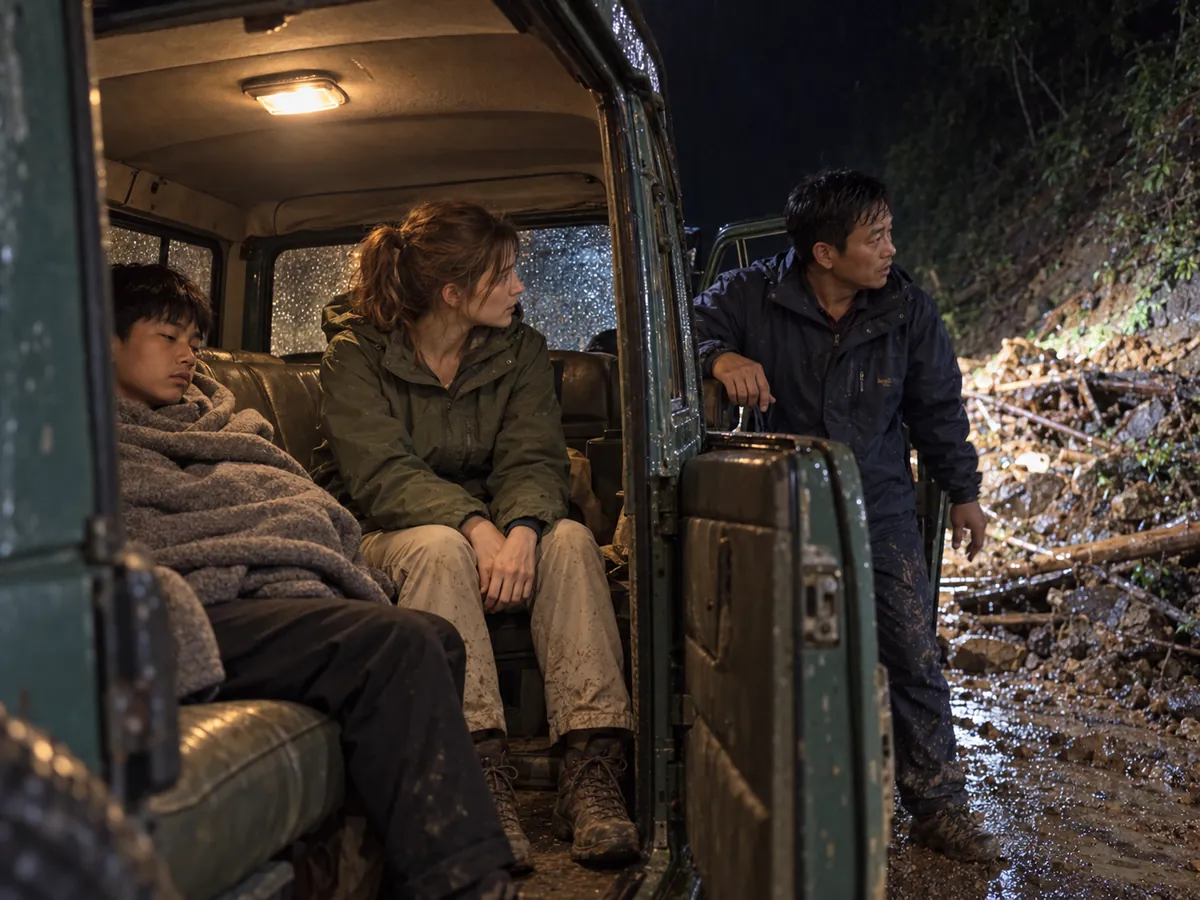
I didn’t think. I had a boy’s legs in my arms and the sound of a freight train coming down a hillside in the dark of northern Vietnam.
“Bác Sáu! Chạy đi!”
The old man didn’t need telling twice. He killed the engine and threw himself into the rain. Minh got his arms under Tuấn’s shoulders. I took the legs, carefully, because of the way the left one bent. The boy made a sound as thin as a kitten’s.
“Sorry,” I whispered. “I’ve got you. I’ve got you.”
The torch swung wildly in Bác Sáu’s hand. It lit the wall of mud ahead, ten feet high and still creeping, trees stuck in it like broken ribs. It lit the edge of the road, where the ground simply stopped. And it lit the long black line behind us, rolling down the slope.
“Where?” I screamed.
“Forward!” Minh shouted. “Over the slide!”
“It’s still moving!”
“It’s the only way that doesn’t end!”
Behind us, the jeep went. First the rear wheels lifted. Then the whole green body tilted and slid sideways into the dark, taillights spinning like a lost flare. I heard the metal tear. I understood that thirty seconds earlier, I had been sitting in it.
Then the mud reached my ankles.
—
Years later, standing in other countries I never believed I would see, I would still think of that slope. It wasn’t solid. It was a river of earth that had learned to breathe.
Every step sank to my knee. Every time I pulled a foot free, the ground sucked at it. Rain hammered the back of my neck, and my hands had gone so numb I couldn’t tell whether I was holding Tuấn or whether the cold was holding me.
“Left!” Bác Sáu shouted. “Đá! Rock is solid!”
I saw it then, a black shoulder of stone rising out of the slide, twenty metres away.
Twenty metres. It might as well have been twenty miles.
Halfway there, my left leg went in up to the hip.
The mud closed around me, and it was warm, which was the worst part, warm as a held breath. I tried to pull. I tried again. The harder I fought, the tighter it gripped.
“Minh!”
He turned, and the torch caught his face.
“Don’t let go of him,” he said. “Whatever happens, do not let go.”
“I’m stuck!”
“I know.” He passed Tuấn’s weight to Bác Sáu and crawled back towards me on his belly, spreading his arms wide. “Ema. Mud is like fear. The more you fight it, the tighter it holds. Stop pulling.”
I thought of the Mekong. The rain on the plastic curtains, and how I had pressed both feet against the floor of that boat as though I could hold the whole river steady by myself.
I had never once let go. Not on the boat. Not in the year before it.
*Stop pulling.*
I closed my eyes and let my weight go slack. I counted. One. Two. Three.
On the fourth count, the mud let me go with a long, wet sigh.
—
We reached the rock as the first grey light crept over the ridge.
We lay on it in a heap, shaking and filthy. Below us the slide had settled into a vast brown scar where the road had been, with one green taillight blinking up from the middle of it.
I started to laugh. I couldn’t stop.
Bác Sáu lit a cigarette with trembling hands, looked down at the wreck, and said something short.
“What did he say?” I gasped.
“That he was never going to sell it anyway,” Minh said. His mouth twitched.
I laughed until I cried.
It was Tuấn who stopped us.
A small hand closed around my wrist, so weak I almost missed it. His eyes were open.
“Chị,” he whispered. *Big sister.* “Chị kể tiếp đi.”
I looked at Minh. “What is that?”
“He wants you to go on with the story.” Minh’s voice had gone rough. “He heard it. All of it. In the jeep.”
My blood went cold. *All of it.* The Tuesday morning. The eleven minutes. The tea that was still warm.
“Tuấn,” I said. “How much English do you speak?”
He gave a small smile, even with the blue still in his lips.
“School,” he whispered, in careful, perfect English. “Six years. My teacher say I am very good.”
I pressed my forehead against his hand and wept.
—
The helicopter came at 6:40.
It was a small red thing with a faded cross on its side, sent, Minh said, because the nurse had spent the whole night shouting into a radio. They winched Tuấn up in a basket, the grey sweater still tucked under his chin, the one that had once held the last smell of home.
I watched it rise and felt a pang I hadn’t expected. It was only wool. But I had carried it from the other side of the world, and now it was going over the mountain without me.
At the top, he turned his head and lifted one finger. I lifted mine.
Then the door closed and the helicopter swung away, and there was only the dripping of trees.
“Come,” Minh said. “There is a village below. They will have tea.”
I tried to stand, and my knees folded.
“Ema.”
“I’m fine.”
“You are not fine. You have been awake for twenty-six hours.”
“No. It’s not that.” I put my hand against my jacket and felt the three things still there: the cup in its cloth, the notebook, Mum’s photograph. “The bag. My passport. My money. My bank card. It was all in the backpack, Minh. It’s in the river.”
For the first time since the slide, he had nothing to say.
I did the sum out loud, the way I used to when I was little and afraid. “My visa runs out in two days. There’s no road. There’s no passport. And I can’t leave Vietnam without one.”
—
The village was a cluster of stilt houses around a stream, and it was already awake. Women stood in doorways with their hands over their mouths. Someone had lit a fire in the yard of the largest house.
A woman I had never seen before crossed the yard and took my face in both hands.
She was small and weathered, in a faded blue headscarf. She said something I couldn’t follow, and her eyes were wet.
“Tuấn’s mother,” Minh said quietly.
I tried to say I was sorry. I didn’t know how. I tried to say it was the men who had dug, not me, and the words stuck.
She didn’t wait for them. She led me to the fire, sat me down on a low plastic stool, and pressed a bowl of rice and pork into my hands.
I stared at the stool.
It was red, and cracked at one leg. A dog slept underneath it, and the rain dripped off the roof in a line.
*You would love this*, I thought, and my throat closed the way it had in Bangkok.
For a second I nearly refused. Old habit: *no, I’m fine, I couldn’t.* I thought of the woman on the Mekong, patting the empty space beside her.
I took the bowl.
I ate every grain, and Tuấn’s mother watched me with her hand on my shoulder, as though she were feeding something that had been very far away for a very long time.
—
The officers arrived at nine.
There were three of them, in green uniforms, mud to the knee. The oldest had a clipboard and a face like a closed door. He spoke with Minh for a long time. I caught my own name twice, and the word *hộ chiếu*, and I didn’t need a translation.
*Passport.*
Minh came back, and he was frowning.
“They are not angry. They are grateful. But the hospital will ask for your papers, and so will the police when you try to travel.” He rubbed his eyes. “The road to Hanoi is closed. There is no way to the embassy for at least three days.”
“My visa—”
“I told them.” A beat. “He says a lost visa is an offence, and he can’t make an exception. He says by tomorrow night you are in the country illegally.”
My stomach dropped. Everything I had done, the dark gap beneath the tree, the rope bridge, the slide, and now this.
*I can’t go home*, I thought. *I sold the house. I gave back the keys. There’s nothing to go home to, and nowhere else I’m allowed to be.*
“Ema.” Minh touched my arm. “Look.”
The village had gone quiet. People were turning towards the stream, where a boy of about ten was running up the path, shouting and waving something bright and orange above his head.
My backpack.
It was soaked, torn at one strap, and plastered with weed. A fisherman had found it a kilometre downriver, snagged on a branch, and half the village had run to meet him.
I took it with shaking hands.
I tore open the zip pocket. Water streamed out. Inside, folded in the plastic wallet that I had bought in some airport, was my passport, damp but whole.
I opened it to the stamped page.
The date was four days earlier than I’d thought.
Not two days. Not tomorrow night.
*Today.*
I looked up. The officer with the clipboard was watching me, and he had seen my face change.
“Minh,” I whispered. “What’s the nearest border?”
He glanced at the officer, then at the map on his phone, then at the sky, where a new line of cloud was gathering behind the ridge.
“Laos,” he said slowly. “Three hundred kilometres. Over the mountains. And you have until midnight.”